1% Earned Income Tax Levy with a 1.7 mill Property Tax Reduction
Sylvania Schools remains committed to providing a high-quality educational experience for every student while being responsible stewards of community resources. For many years, the district has worked to carefully manage costs, maximize efficiencies, and extend existing funding as long as possible, all while maintaining strong academic programs, extracurricular opportunities, and student supports. This levy represents an opportunity for the community to consider how best to sustain those opportunities in the years ahead.
What is an Operating Levy?
An operating levy provides funding for the ongoing expenses to support regular educational and operational activities.
Operating levy funds may be used for areas such as: Teachers and support staff, Classroom Materials, Technology, and Instructional Resources, Student Support Services, Transportation, Math and Reading Intervention Services, Nursing Services, Utilities and building operations, Safety and Security Needs, and Extra-curricular activities.
What is on the November 3, 2026 Ballot?
Sylvania Schools is asking the voters to consider a 1% Earned Income Tax with a 1.7 Mill Property Tax Reduction.
The 1.7 Mill Property Tax Reduction would decrease property taxes by $35 for every $100,000 of assessed home value.
Who Pays the Earned Income Tax?
The 1% applies to earned income only, not to retirement income.
Taxable Earned Income Includes:
• W-2 wages, salaries, tips, and other employee compensation (after pre-tax deductions like traditional 401(k)/403(b), health, dental, and vision insurance premiums, FSA, HSA contributions).
• Net self-employment profit from sole proprietorships, independent contracting, or partnerships.
Does Not Apply to
• Social Security and Pension Income
• IRA, 401k, 403b, 457, and Roth Distributions
• Investment Income – Interest, Dividends, Capital Gains
• Estate, Trust, Inheritance, Gifts, Life Insurance, Disability, Workers’ Comp, and Alimony Distributions
• All other Retirement Benefits and Distributions
Only residents of Sylvania Schools pay the tax. Non-residents working inside the district do not pay the tax.
How long has it been since school district taxpayers have approved additional operating money?
The last time Sylvania Schools taxpayers approved additional operating money was in 2016.
What reductions have taken place prior to the levy request? How much did it save the district?
The district has reduced over $2 million throughout the past two years. This includes reduction of budgets, reducing staff - teaching, high school counselors and media specialists, and the reduction of administrative salaries. This summer the district absorbed three administrative positions saving the district $380,000 heading into Fiscal Year 2027.
What happens if the levy doesn’t pass on November 3, 2026?
Failure to receive operating revenue in calendar year 2026 would require the district to reduce expenditures in order to balance the budget and to maintain financial stability.
Projected reductions in order to balance the budget would include, but would not be limited to:
How much is the proposed 1% Earned Income Tax Levy going to cost me?
Estimated annual cost:
Earned Income | Annual Cost |
$50,000 | $500 |
$100,000 | $1000 |
$150,000 | $1,500 |
$200,000 | $2,000 |
$250,000 | $2,500 |
How much will my property taxes be reduced?
Estimated annual reduction:
Assessed Home Value | Annual Reduction |
$100,000 | $35 |
$200,000 | $70 |
$300,000 | $105 |
$400,000 | $140 |
$500,000 | $175 |
Why is Sylvania Schools requesting this levy now?
Sylvania Schools is requesting this levy to preserve the high-quality educational experience and opportunities that our students, families, and community have come to expect.
Over the past decade, the district has worked to responsibly manage resources while continuing to provide strong academic programming, extracurricular opportunities, and student supports. However, like many school districts across Ohio, Sylvania Schools is now facing a combination of rising costs and limited revenue growth.
The cost of operating a school district has increased significantly in areas that directly impact students, including:
Specialized student services, particularly for students with more complex learning and support needs
Employee wages and benefits
Transportation and fuel costs
Utilities and building operations
Instructional materials and classroom resources
These increases are driven not only by inflation, but also by the growing and evolving needs of students.
The district's five-year forecast shows spending outpacing revenue every year through FY 2030. Because of that, the district's fund balance is projected to shrink from about $28.8 million at the end of FY 2026 to roughly $12.3 million by FY 2028, and then run out, dropping to about ($1.4 million) in FY 2029, ($18.7 million) by FY 2030, and ($18.7 million) by FY 2031. Ohio school districts cannot have a negative ending fund balance at the end of a fiscal year.
How has state funding affected Sylvania Schools?
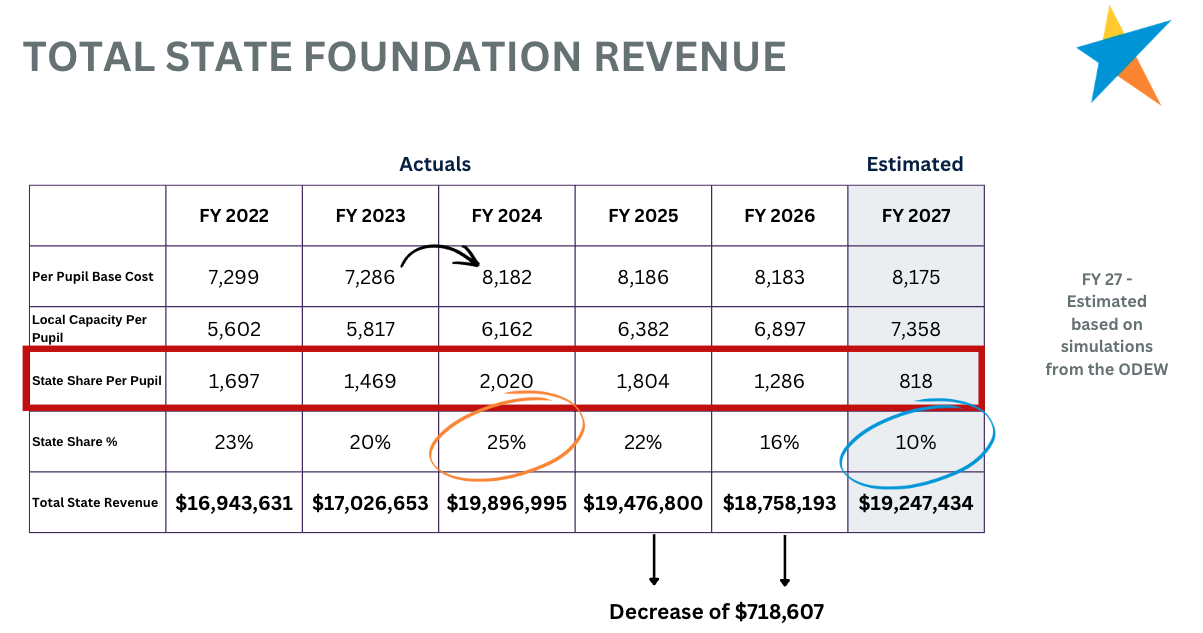
Sylvania Schools receives state funding through Ohio’s Fair School Funding Plan, which is designed to distribute resources based on a district’s capacity to generate local revenue. Because Sylvania has relatively higher property values and household incomes compared to other districts across the state, the formula assumes that a larger share of funding can be generated locally through property taxes. As a result, the district receives a smaller portion of its total funding from the state than many other districts. While the formula is intended to create equity statewide, it also means that Sylvania Schools must rely more heavily on local support to maintain its educational programs and services. Click Here for a video explaining the Fair School Funding Plan
The graphic below shows the history of state foundation revenue and an estimate for Fiscal Year 2027.
Have the district’s expenditures increased? How?
Sylvania Schools, like many districts across Ohio, continue to experience rising operating costs driven by both inflation and increasing student needs. Expenses have grown in key areas such as employee wages and benefits, utilities, transportation, and instructional materials. In addition, the cost of providing specialized services, particularly in special education has increased as student needs have become more complex. These are essential services that directly support student learning, safety, and well-being. While the district works to manage costs responsibly, many of these expenses are outside of local control and continue to rise faster than available revenue, creating ongoing financial pressure on the district’s operating budget.
Since 2019, Sylvania Schools’ general fund expenses have increased at an average annual rate of approximately 2.93%, which reflects a strong commitment to fiscal discipline during a period of significant economic pressure. Over that same timeframe, districts have faced higher inflation, rising insurance costs, increased transportation expenses, and necessary wage adjustments to remain competitive and retain quality staff. Keeping expense growth below many of these external cost drivers demonstrates the district’s careful budgeting, cost-control efforts, and strategic decision-making. This measured growth has allowed Sylvania Schools to continue providing high-quality educational programs and services while maximizing the value of every taxpayer dollar.
Below you will find graphics showing expense growth in key functions of the district from Fiscal Year 2022 to 2026.
How does Sylvania Schools compare to area districts and demographically similar districts in key financial metrics issued by the Ohio Department of Education & Workforce?
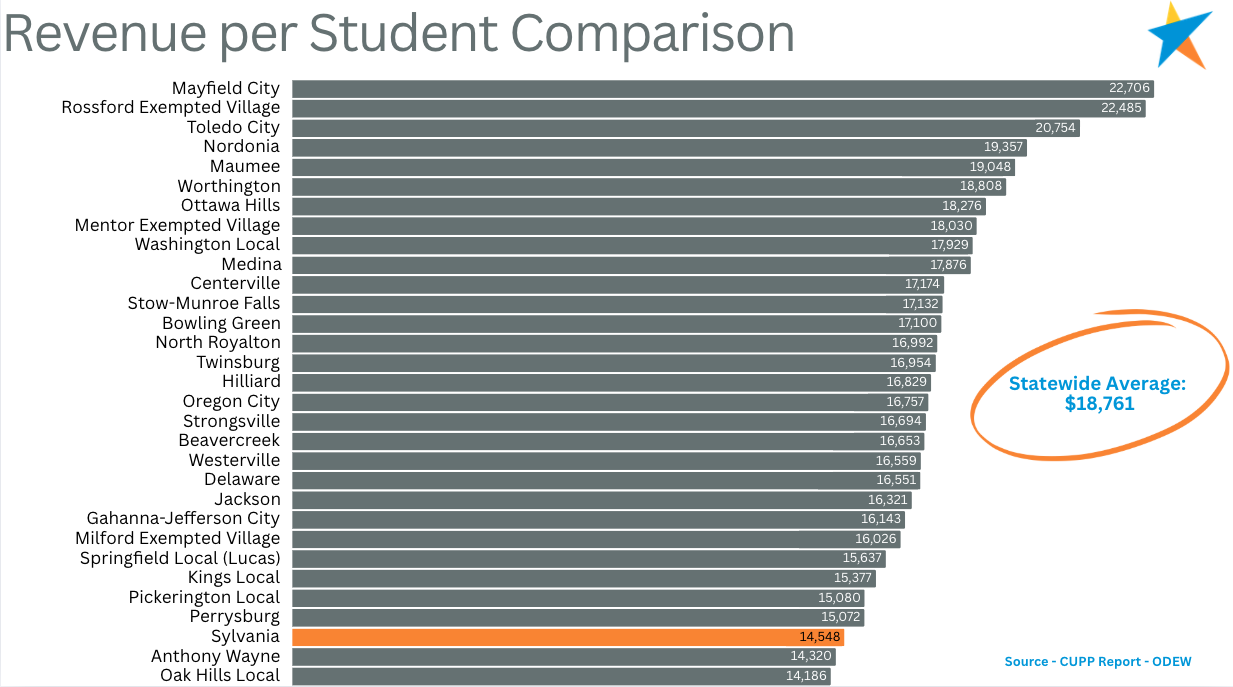
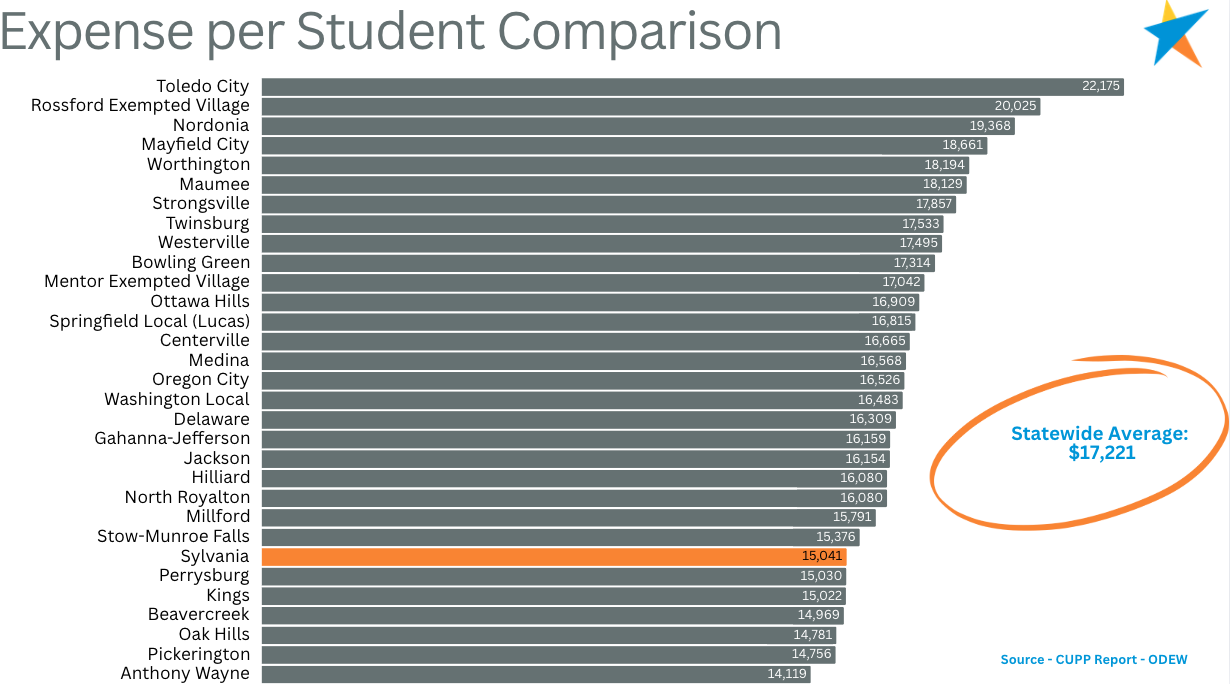
Revenue per pupil and expense per pupil are important measures used to understand how much funding a district receives and how efficiently it operates on a per-student basis. In Sylvania Schools, both revenue per pupil and expenditures per pupil are relatively low compared to many other districts, reflecting a district that operates efficiently while maximizing available resources. This means Sylvania is able to provide a strong educational experience at a lower cost per student, demonstrating fiscal responsibility and careful stewardship of taxpayer dollars. At the same time, lower revenue per pupil also means the district has fewer financial resources available to absorb rising costs, making it more challenging to sustain programs and services without additional funding.
Administrative costs per pupil in Sylvania Schools are lower than many other districts in Lucas County, reflecting a strong commitment to directing resources where they matter most—into the classroom and student services. This means a smaller portion of the district’s budget is spent on central office and administrative functions, while a greater share supports teaching, learning, and student opportunities. Maintaining low administrative costs is a deliberate effort to operate efficiently, streamline operations, and ensure that taxpayer dollars are used effectively. This approach demonstrates Sylvania Schools’ focus on prioritizing students while responsibly managing overall district expenses.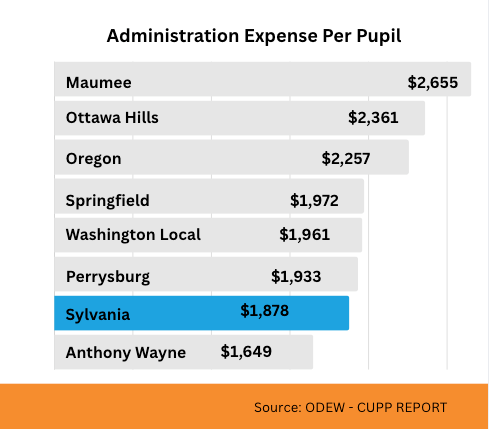
How do Sylvania Schools taxes compare to other local districts?
Below is a graph comparing total school district taxes paid by a resident in each of the schools listed. The following assumptions are used in the comparison: $100,000 assessed property value and $50,000 of earned income. When comparing total local tax contributions, Sylvania ranks toward the lower end among local districts. This reflects a positive position for the community, as it demonstrates strong educational programing delivered with a comparatively lower local tax burden.
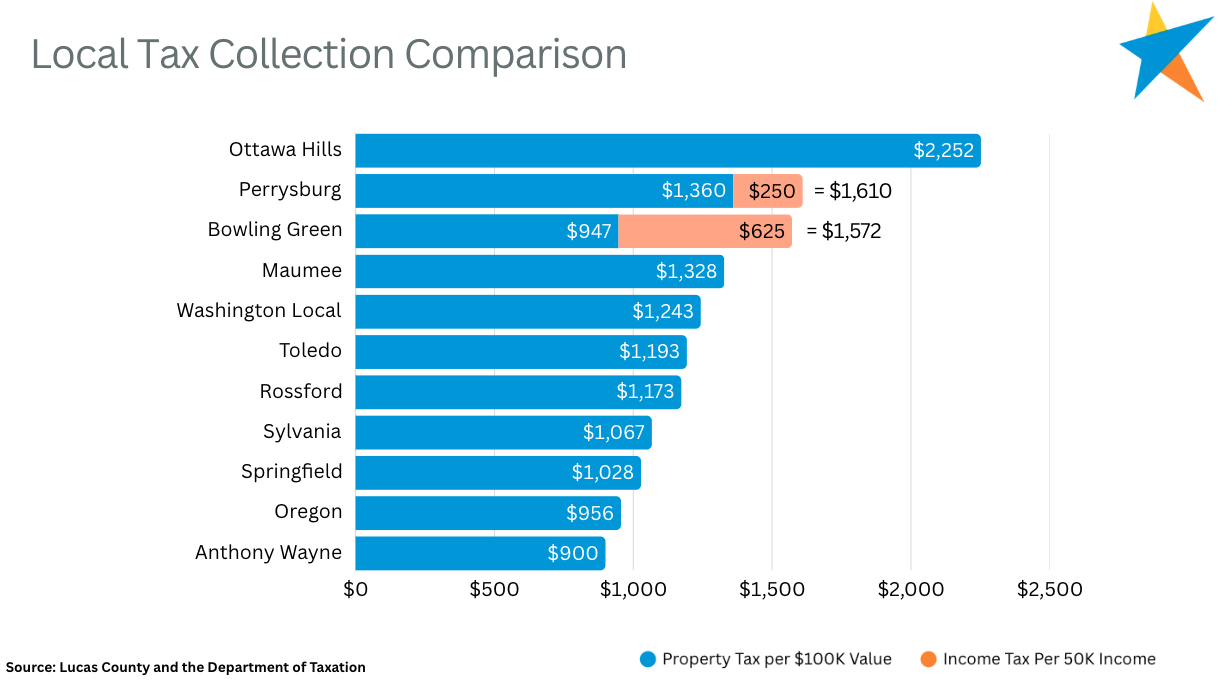
Rates above include the effective rate paid to Penta Career Center for Springfield, Perrysburg, Maumee, Rossford, Bowling Green, and Anthony Wayne.
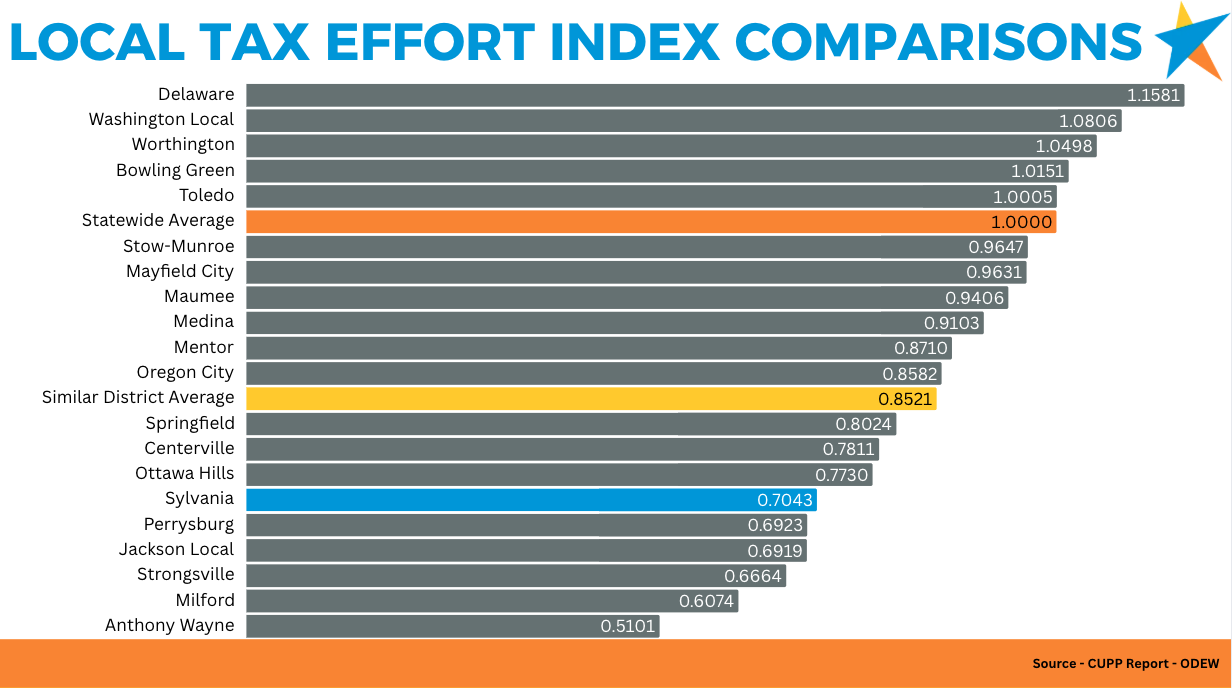
Another district by district comparison available from the Ohio Department of Education & Workforce is the Local Tax Effort Index. The Local Tax Effort Index is the ratio of any school income tax and property taxes charged versus the income of the residents. It compares what a district actually collects in local taxes vs. what the state believes the district could reasonably collect based on wealth. It answers the question - “Is this district taxing itself at a level consistent with its capacity? The average effort statewide is 1.0. Sylvania has a Local Tax Index of .7043. Sylvania’s index of 0.7043 reflects that our community has strong property values and historically lower millage rates compared to many Ohio districts. This does not mean our residents are not contributing significantly to our schools, it means that relative to our wealth, our tax effort is lower than the statewide average
The graph below compares the Local Tax Effort Index to schools in Lucas County and schools throughout the state that are similar to Sylvania.
My property was recently reevaluated and I am paying more taxes. Isn’t the school district receiving all of it?
No. Even though property values may increase during a reappraisal, Ohio law (House Bill 920) generally prevents school districts from receiving a proportional increase in revenue from existing levies. When property values rise, the effective tax rate is automatically reduced so that the district collects approximately the same total revenue as before from those voted levies. In other words, HB 920 is designed to limit revenue growth on existing levies, even as property values change. However, individual tax bills can still increase due to factors such as inside millage (which is not reduced under HB 920), new construction, or changes in property values relative to others. As a result, while some homeowners may see higher tax bills, the school district does not receive a corresponding windfall in operating revenue from those valuation increases alone.
The valuation recently increased by a total of 28.8% during the 2024 re-evaluation but our revenue increase was only around 2%. The graphic below shows a history of revenue collections in the General Fund and an estimate for 2027.